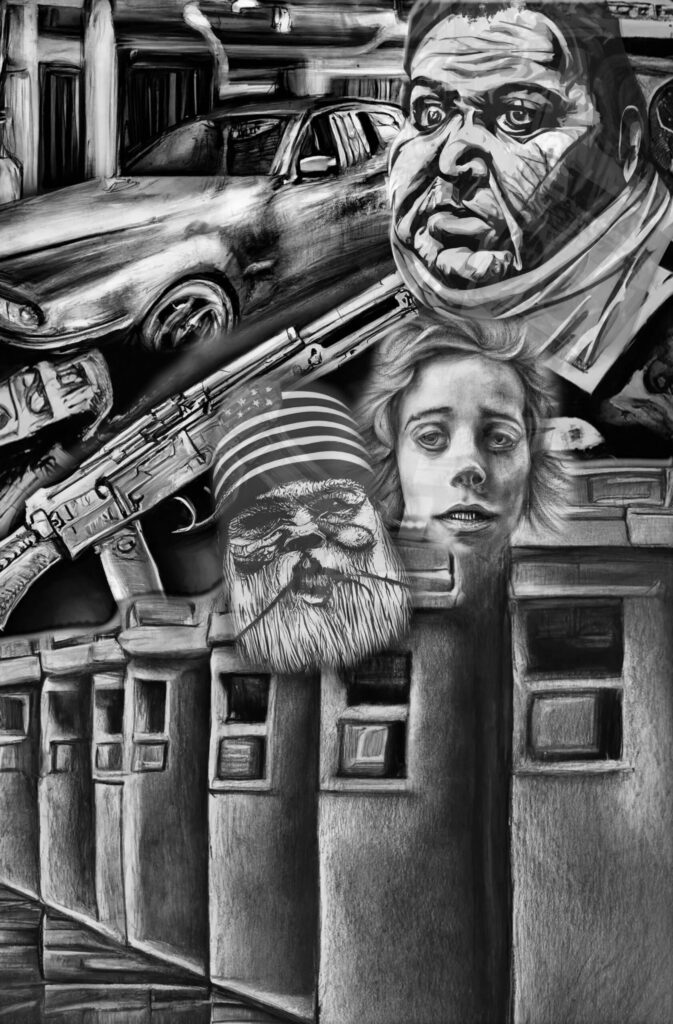
Patrimonious

“That’s good humor,” Brad chuckled to himself when he received the latest invoice from his subcontractor in Arizona. He had no intention of paying it, like so many other debts before. For all of his life, Brad had wanted to feel important. So he started businesses that sounded prominent and exclusive. An ATM company, an appliance distributor, and, most recently, a “Do-It-Yourself” auto-repair shop. Paying people wasn’t his thing. Daily three-hundred-dollar steak dinners were no problem. Leases on trucks and sports cars. Rent on a mansionette when he lost his house to creditors. Keeping up the appearance of success was more important than actually being successful. And definitely more important than paying the people who actually made him all of his money.
Since Brad’s trophy-wife left him, he’d been desperately trying to cling on to some semblance of youth. A meager 4’10” with a protuberant nose that gave away his Armenian heritage, Brad was never attractive to the ladies. In his younger days, his two-hundred-pound frame may have passed for ‘stout’. With the weight he’d gained the past several years, he looked more like a balding schnoz sitting atop an overinflated water-balloon. Even after the rhinoplasty and electrolysis, he still felt insecure with his looks and tiny penis. Baby dick, teeny-weenie, nanochoad – he’d heard them all. Money, however, made him feel better. Everybody was attracted to money. With his family’s shysterous history, he had done all he could to drop the ‘Marsoobian’ moniker. Aside from actually changing his name, that is, which would be unmentionable in his culture. Brad liked it when people called him, “Soob”. The license plates on his collection of conspicuous vehicles were customized SOOB 1, SOOB 2, etc. His email address would be ‘soob@whatevercompanyhemadeup.com’. It didn’t help his reputation around town when his wife started telling everybody that he was abusive and would rape her. But he knew that you can’t rape your wife.
His father, Arsen, had taught him that most people wouldn’t come after you for a negligible amount of money, especially if it meant putting their reputation on the line. The trick was finding that sweet-spot between someone taking a loss and finding an attorney. Brad preferred working with independent contractors. Service-people starting their own small businesses. Not only did he not have to pay for things like insurance, payroll, workers comp, tax services – but they, and the labor boards, were less likely to come after him when he didn’t pay. The sweet-spot, at least in California, where Brad did business, was around ten-or-fifteen grand. He lauded the marvelous day that the state raised the small-claims limit from five to ten-thousand dollars. He’d virtually doubled his profits overnight. Before that, he’d considered leaving the state, since they were making it harder for him to get rifle components and debit-card skimmers. It was just so damn easy for him to launder money and evade taxes there.
“Sup, Soob?” Miller came through the bay doors of ‘The Garage’, packing a fresh box of reds against the hip of his dirty blue-jeans. He stuck a smoke in the slit of his douche-goatee™ and grumbled with a timbre that can only be produced with help from the tar of a million full-flavored cigarettes, “You ready for this shit, brah? Want Dave to pull into this one?” He meant the service bay he was standing in, flicking ashes into puddles of oil and cat litter.
“What’s up, my dude?” Dave McColm, leaned out of the open “Superior Appliance Specialists” van as he backed it through the gaping roll-up entrance.
“Matthew! Stop!” Brad shouted across the warehouse. His son, who was autistic, liked to open one door to the office, go through it, close it behind him, go to the other door, open it, go into the garage, and so forth. “Motherfather! Go play with your iPad!” He roared at the boy when the door slammed again. Matthew retreated into the office and closed the door a final time. When Brad’s wife left him, she didn’t take anything with her. Not even the kids. Brad had managed to ship his oldest son, Nicholas, off to a military boarding school somewhere on the east coast. His daughter, Sydney, was sixteen and he’d parentified her into Matthew’s primary caregiver. She still had to go to school for another year. Then maybe he’d leave Matthew with Sydney and start a new life and a new business somewhere his name wouldn’t follow him.
Brad held the button to lower the corrugated-steel door while Dave Miller, the first Dave, plugged impact wrenches into hoses that hung from the thirty-foot ceilings. Dave McColm, the second Dave, stepped from the van, leaving the stereo on full-blast to Bon Jovi. Not even the good stuff, but 2000’s Bon Jovi, when he couldn’t decide if he was pandering to pop-country or country-pop audiences.
McColm pulled the oversized remote-control-on-a-cord from the lift-bay and pressed the arcade-style button to raise the van skyward. Ceilingward.
Miller moved in a circle under the Ford Econoline, unfastening the bolts that held a second gas tank. The van came equipped with two tanks, but they’d emptied and disabled one to give access to the underside of a tool chest in what would have otherwise been the passenger compartment of the stripped-down interior of the service vehicle. Brad and the other Dave lowered the empty fuel reservoir to the ground and resumed their positions as members of The Village People, holding their arms spread overhead to support the weight of the false-welded panel. Dave was now unfastening with loud whirrs followed by gentle clangs as the ten-millimeter bolts fell to the concrete.
They would only be traveling in-state, not crossing any borders, but had decided it would be best to be cautious. Clever, they thought. There was extra investor money available after buying this old repair shop. Inside the van were stacks of bolted-in metal tool cabinets. Most of them were the standard fare you’d expect to see for appliance-repair: wrenches, screwdrivers, power drills. A couple of them, however, drawers permanently ‘stuck’ closed from the cargo section of the van, had a rectangle of sheet metal bolted to the the bottom.
It was below these sheets of aluminum that Brad and McColm squatted to support the weight that had been released by Miller’s air-wrenching. They slowly eased the plate to the ground before dropping it from about six-inches above the floor, uncertain who would set it down first to avoid smashed fingers. The deconstructed weapons and ATM parts spilled from each side, into the automotive fluids.
“Watch it, fuckers!” Miller jumped out from under the lifted van. “You don’t think you could have swept up before we got here?”
They each three loaded up armfuls of manufactured metals and plastics and hobbled across the shop space, stepping over lowered hydraulic lifts and around industrial-size waste barrels of used motor oil. The false-bottom of the van unloaded and bolted into place, Brad and the two Daves returned to the tables where their bounty had been dumped haphazardly. They plunged their meaty hands into the piles, emerging with a carbine barrel or collapsible shoulder stock. False fronts for keypads and MAG-stripe readers. Each of these, they wiped with white terrycloth towels to remove grease and oil and kitty litter. They laid the items out into neat columns and rows as space cleared on the tables. The trio stepped back to admire their harvest. Brad took a photo with his latest-model-of-iPhone.
“Text that to me.” Dave #2
“No, dumbass. You shouldn’t even be taking pictures of this shit.” Dave #1
“Fuck you. If he doesn’t text it to me, I’ll take a picture myself.” Dave #2, searching his pockets for the device he’d left in the elevated van.
“Whatever. Get one with me in it.” Dave #1 handed his phone to Brad and held his pants up as he jogged the eight feet to the table. Brad fiddled with the camera phone, trying to figure out how to open the app. Dave pulled an American-flag bandanna from his back pocket and tied it over his bald-yet-shaved head. He picked up some AR-15 components and held them in both hands like a crude rifle with an invisible magazine and receiver section. If the gun-makers could only patent that technology. Coming soon from GunCo: It’s the Mr. Invisible Assault Rifle. Make all of your finger-gun dreams come true with the future of school shooter technology! Also comes in officially-licensed Hello Kitty pink, desert camo, jungle camo, woodland camo, Arctic Tundra camo, and new Urban Eagle Patriot’s Elite© urban camouflage! Those pansy-ass, woke, crybaby, hippies won’t see it coming!
Brad and Dave and Dave had all met through the Superior ATM company that Brad started almost a decade ago. His longest-running scam. The company didn’t actually do anything. Brad, or Brad’s assistant, really, would find service-people around the country who would do some occasional ATM repair work. Computer and appliance techs, mostly. ATMs are simple machines that only use a handful of parts. Aside from the keys, these technicians likely had all of the tools they’d need already. Brad had hundreds of copies of the keys that he’d mail out to anybody who asked. It only takes about four keys to get into every type of terminal – the ones that aren’t attached to a bank, that is. They didn’t get involved with those, or the second part of the scheme would never have worked.
The first part of the stratagem, though, was more egocentric. Even before having any relationships built with remote technicians, Brad began marketing himself, always Mr. Big, as the guy who owned the company with technicians around the country. Impossible-to-find ATM service-people whose labor he could charge an exorbitant markup on. The ubiquitous terminal owners, the CardTronics and the Solvports and the NationalLinks would have Brad’s phone ringing off the hook, willing to pay hundreds in expedited-service and fuel-surcharge markups to get their machines repaired. Little did they know that the majority of his “staff” were part-time computer techs who saturated the area. The specialist he’d told to drop everything and drive three hours to get to their location – usually some tourist waypoint or stripclub with eight-dollar service-fees – lived eight blocks away and was taking a nap when Brad’s assistant called.
This might sound bad enough as it is, marking up other’s labor to maintain a lifestyle significantly better than that of those earners. And lying about the extra time and labor that went into completing the job. But that’s what American capitalism is built on. As far as Brad was concerned, what he was doing was ‘shrewd business’. He didn’t know what that first word meant, but it sounded cool and was in movies.
His family was one of the cornerstones of the local Armenians-only church. They’d been in this city since all there was was downtown. Since the miles of mixed-use offices and mini-storages and fast-food standalones with their exhaustive white-line-over-asphalt yards were figs and oranges. Brad had been raised in the church. But what he was doing wasn’t stealing. If someone is dumb enough to get tricked out of their money, that was their problem. Buyer beware. The Marsoobian Mantra. Even if it was theft, it’s not wrong to steal if you need to feed your family. And he had a family.
This, dear brain narrator, is where you might start to think that even if taking a little off the top while making no contribution to society is okay, the next section isn’t so okay. Or maybe you do, I don’t know what you think is right or wrong. I’m not going to make that distinction on your behalf. While I allegedly might – theoretically – condone tax fraud or certain types of corporate espionage, people like Brad are truly bottom-of-the-barrel and would better serve the world as carrion.
What would happen after the mythological specialist would fix the ATM – which was usually just a receipt printer jam or someone stuffed a gum wrapper in the card reader – was that Brad would invoice the company that owned the ATM but would fail to pay the invoice of the service technician. For a couple of months, it would work. He’d tell the contractor it takes sixty days for him to get paid and he couldn’t afford to pay them immediately. Plus, he’d add, it’s the industry standard. All the while, they’d be doing more and more service jobs for Brad while he represented them to his clients as employees – hand-selected experts. Like he was busy around the country around the clock. When the technician would eventually ask again about their unpaid invoices, Brad would make up a story about how the client was being difficult. They didn’t get the photos of the ATM they wanted or the test-receipts were cut off. He’d go so far as to send the tech back to the service locations to get the information if he knew the terminal was out-of-order again. He’d finagle his way into getting them to fix it for free while they were out there. Or at least, he would tell them, he couldn’t pay their mileage. Not that Brad was going to pay any of it. If he could time it right, he could bill the client an extra $150 for an ‘express’ response.
Most of the time, after a few months and a couple-dozen unpaid service tickets, the tech would refuse to take any work from Brad until he made good on at least some of the invoices. If it was a particularly busy area, Brad would pay a token amount to stay in their good graces and get another month or two out of them. Gotta spend money to make money. He dragged this on for years with a few of them. Those who caught wise made threats, but since they’d never met in real life, didn’t even know if Brad Marsoobian was a real person, there wasn’t much they could do. Payment of four-to-five and later, when the small-claims limit was increased, ten-to-fifteen-thousand dollars wasn’t worth any out-of-state legal action. The technician would spend half of that in travel and expenses. That is, if they could ever collect. Otherwise, it would amplify their losses. In the end, they’d have to bend over and take it. Hours of their work. Miles traveled on their own dime. There was nothing reasonable that they could do about it.
So that’s the first part of the ATM company scam.
The second part, that’s where Dave and Dave come in. They started out as service guys. Unfortunately for Brad, they lived in California, so they could come knocking for their money. And knock they did. At the time, Brad had a little one-room office in one of those single-story “executive suites” places where rows of buildings surround the parking lot. The “suites”, which are stark two-hundred-square-foot rooms with no amenities, look into the nearest parking stall. Commercial-grade, unpadded carpet and a couple of electrical outlets. There was a solitary unisex restroom facing the driveway that was shared by a score of other tenants. This was the official business address of Superior ATM. The address that the checks from the processors were sent to. The address he’d printed on business cards and invoice headers. Brad liked this place because the suite numbers had a letter and a three-digit number, which made it sound to his clients in Houston and Chicago and Seattle like he was in a towering office that dwarfed the surrounding buildings.
This diminutive one-room office was bordered by two other identical rooms on either side, other fly-by-night businesses. The door and window, like a slummy apartment, faced the inner-donut that was the parking lot, separated by only four feet of sidewalk and a dying boxwood. The back of the building lacked a window, but if it were there, it would have looked out at street-level onto the four-lane boulevard that was proprietated by similar rent-by-the-month, cash-preferred landlords.
So the Daves, they find Brad, a real person, not a made up name. It was pinheadedly surprising. They didn’t look him up at the same time. Separate Daves, separate days. Dave met Dave through Brad. They weren’t brought in on the first part of the operation. No, with three of them, they could carry out a heist that would go unnoticed – or unreported – except as a minor loss on his client’s taxes.
When a service call came in near where the Daves and the Brad were colluding, one of them would act as the technician. He’d go out there and fix whatever problem was going on with the ATM. You remember how all of the keys were the same for those stand-alone machines? Well, as it turns out, most of the safe combinations and programming passwords were nearly as universal. The big corporate competitors, the ATMLinks and FirstNationals and ATMMachines [sic], used the same combos and codes for all of their hundreds, even thousands, of terminals. Those who were smart enough to randomize their passwords kept a list. When Dave or Dave went out to repair the machine, the client would provide the safe code and master passwords. He or he would need them to carry out their business. Soon, Dave and Brad and Dave had a list, too.
After the first Dave would go do what he did, the second Dave would return to the location a few days later. That is, if the first Dave scoped it out and made sure there weren’t any cameras on or around the terminal. Most of the machines in liquor stores and dive bars had no cameras facing them. And those mirror-disks stuck to the front, those are for you to see behind you. Virtually no ATMs had cameras in them unless they were at a bank.
The second Dave, he would be at this gas station or smoke shop or in the front lobby of a Target, pretending to be browsing or whatever. Meanwhile, Brad was back at his computer in the one-room office. The first Dave would be leaned over his shoulder, watching him dial the terminal that the second Dave was milling around near. See, those ATMs with the four-inch screen and the plastic shell over a steel safe, they process your transaction – verify there is money in your account and then tell your bank to transfer the amount to the processor – using an old-timey modem. The kind that go beep-boop-boop-boop-beep-bzzzz-king-ggggggggg-bong-ppprrr-kabee-kabee-pssssshhhhh. That’s why it takes so long to get your cash. Those modems, as you may remember from history books, worked both ways. What Brad would be doing in his office, Dave One over his shoulder while Dave Two pretended to shop, he’d call into those machines and reprogram them to think they had one-dollar bills in them instead of twenties. Then Dave Two would take out his card – the debit card for his special account that he kept $105 in just for this, they each had one – and he’d make a withdrawal. The ATM, thinking it had ones in it, would spit out two-thousand dollars in crisp portraits of Alan Andrew Jackson. Brad would set the bill denomination back to the proper amount and delete the logs. Dave would buy a Pepsi and a pack of smokes for other Dave.
It was an extra six-or-eight grand in their pockets each week. If and when the owners of the machines noticed anything amiss in their counts, they’d call Brad to have a technician (Dave) go pull the logs from the machine manually, because they couldn’t find the discrepancy from their workstations in Nashville or Minneapolis or Dallas. Of course, the technician never was able to find anything. Even if they were to check security footage. Even if it existed. Even if it took hours to go through because they didn’t know when the dispenser ‘error’ happened, they wouldn’t find anything except regular customers, regular transactions.
This went on for a while. They moved from the street-side shed of an office to a space with private offices for Brad, his assistant and his assistant’s assistant. A thousand-square-foot warehouse gave them room for plenty of parts – dispensers and keypads and dip-readers – that they kept on hand for any of the mysterious problems that clients might have. They’d rotate the parts out for a ‘new’ one from their stock, charge the client for the part, take the ‘defective’ part for disposal, then add it to their stock for the next customer. Possibly the same customer with a different machine. There was nothing wrong with these parts. A torn bill jamming the cash chute could be fixed in under an hour. Sure, it was more complicated than unjamming a copy machine, but nothing Dave or Dave couldn’t easily do in the field. If they wanted to wait for Brinks or Loomis to show up, they’d be able to swap a good part for another good part and make an easy five-hundred bucks. Card readers and keypads were an easier fix, but were only worth about a buck-fifty apiece. Sometimes Brad would string a customer along for weeks. “It was working when we left, maybe it’s the card reader?” or “If that didn’t fix it, it has to be the mainboard”.
It didn’t take long for them to go from trading regular keypads and unfaulty card readers out for interfaces that recorded PINs. Stripe-readers that copied account numbers from magnetic tape to a micro SD card. With this information, the master passwords for the terminals, and the dial-in programming software on Brad’s computer, they were able to make transactions at terminals without even using the physical machine. A hundred from this account, forty from this account. The bills would spit out of the lower slot in the ATM just in time for a Dave to walk by and snatch them. A regular Dave on his way for a Diet Pepsi or to the restroom to relieve himself of the same. Dave One or Dave Two would drive down the highway, stopping at a convenience station every few miles to snatch the waiting bills from the mouth of the cash dispenser.
This went well. The ATM repair company, with its overcharged customers and unpaid staff, went well. Brad and the Daves were living well. Eating well. This is where The Garage comes in. That’s really the name. They needed a front for their increased income. Brad already knew, from the two-million he was making annually from the repair technicians, that as long as you wrote everything off, until it looked like you made regular-people wages, the IRS wouldn’t come snooping around. Brad bought The Garage, a six-bay automotive repair shop, at foreclosure. A write-off for the ATM company as a warehouse to store parts and machines for repair. And a write-off again when they started ‘The Garage’ on paper and he sold it to himself. The point of The Garage, as far as the public was concerned, was a “do-it-yourself” repair shop. They’d charge a bit less than if you had a mechanic do the work for you but you ‘got to’ do the work yourself. In their shop, using their tools and lifts. Cool in concept, but a flop in practice. Who wants to pay sixty-dollars-an-hour to work on their own car? It didn’t matter. On the spreadsheet that represented each of the six bays in a column and each hour of the day in a row, they’d put made-up customer names where there were no bookings. Those made-up customers paid them sixty-bucks an hour in clean money. Plus, there were always additional fees. “Mechanic” consultations. Waste and part disposals. It wasn’t hard to get Jim Smith or Tony Martin to spend four-hundred bucks on an hour-long visit to The Garage.
It was in The Garage, on a Sunday, with the bay doors rolled shut and the front-office lights dark that Dave and Dave and Brad were sorting their loot of components across two eight-foot-long folding tables. Dave hands Dave a stack of keypads with red numbers and blue auxiliary buttons to stack in the metal cabinets at the rear of the warehouse.
What about the guns?! You’re probably wondering. Those have nothing to do with any of this. Brad and Dave – I don’t remember which fucking Dave, probably both of them – were into guns. Second-amendment proselytizers who had never read the constitution. They would buy these assault rifle parts and then assemble them into final products. AR-15s, HK-91s, IMI Uzis. They’d sell the weapons to friends and family. In the parking lots of local political events. They had no difficulty finding buyers amongst the congregations of their respective churches.
Shaun had been Brad’s assistant since almost the beginning. When it was just an ATM repair company in a single-room executive suite with no plumbing. When the customers needed their machines fixed, Shaun was the guy who found the technicians. He’d call around to find someone who could fulfill Brad’s empty promises to the clients.
They were running over two-hundred calls a day, and it was all because of him. When Shaun joined, Brad was barely making thirty-grand a year. Still sending faxes. Paper versions of everything shoved into filing cabinets and manila envelopes. No organization. Within a year, Shaun had converted not only Brad’s office to a digital world, but the entire industry. His ideas for technicians using smart-devices to record their service calls and to upload the required signatures and reports changed the business nationwide. This was before iPhone and Android. In the flip-phone days. Shaun had to order two dozen specialty handhelds from Motorola and set them up for their full-time non-employee technicians.
Within two years, Brad was making millions. The ATM service industry had become fast. Too fast. While Shaun had nearly automated the technical part of his own job – the scheduling of technicians and compiling of reports – he’d created an even worse enterprise for himself. By the third year, most of his time was spent reassuring clients who hadn’t received their paperwork immediately after the job was completed that yes, the job had been completed. Like, relax. Just a few years ago, it took weeks for it to be mailed to you, if it was sent at all. Clients had become such douchecanoes that Shaun had suggested to Brad on more than one occasion that they fire a few of the particularly bitchy ones. Brad, of course, would insist that they take every job that came through. It didn’t matter if the clients were asscrackers, they paid the bills.
The technicians would reach out to Shaun about their unpaid invoices. Each time, he would put them on hold and walk into Brad’s office, telling him Michael or Kelly or John or Sean or Dave #3 was on the phone. They’d called Brad’s cell countless times before calling Shaun. Brad would say something about the client being behind on paying their invoices or another client waiting to get photos of the ATM from the technician for the second trip. No, the same pictures of the same ATM doing the same thing in the same place from the week before wouldn’t work. Shaun would usually photoshop these pictures to make them look just slightly different and resubmit them on the technician’s behalf. It still didn’t get the worker paid.
Shaun wasn’t dumb, but it did take him a while to catch on. How Brad would come to him every few months and say, “I need you to find a new tech for San Diego,” or, “We need a backup guy in Phoenix.” Despite his personal extravagance, Brad always seemed to have money problems. Okay, that’s not unusual. People living above their means. But the more revenue Shaun brought into the business, the more replacement technicians they had to ‘hire’, the more Brad seemed to be in debt. Shaun had known Brad since childhood. Brad was his brother’s godfather. Of course he was going to give him the benefit of the doubt. Brad was always the ‘fun uncle’ type. When Shaun was a boy, Brad showed him the trick to solving a Rubik’s Cube – by prying out the pieces and reassembling them on the winning sides.
Brad would show up at the office occasionally with a new, top-of-the-line computer for Shaun, or would have a bed delivered to his house. These minor gestures helped to convince Shaun that Brad was a good guy. When times were good, Brad would take care of Shaun. Even if it was only a fraction of the millions Shaun was bringing in. As such, Shaun figured, he should help Brad when times were lean. When the technicians would call about their invoices, Shaun would tell them, with all sincerity, that he was working on it. He was convinced it was the clients, not Brad, who were causing these problems. He stayed in his office late into the night, filling in the blanks on service-call paperwork. Brad would tell him to “go home” when he’d leave at two or three in the afternoon. Shaun liked to work when it was quiet. When the phones weren’t ringing. When Brad wasn’t belly-laughing into his bluetooth earpiece. When his assistant and her assistant weren’t coming into his office to ask questions about routing technicians or scheduling – things that they should have been able to extrapolate from the hundreds of similar conversations by now.
Brad had hired Stephanie for Shaun without telling him. She was not attractive, so don’t start thinking that’s why she was hired. No, Brad hired her as a genuine assistant for the semi-genuine ATM business. Over a dozen girls came in and out of Brad’s office that day before he decided on Stephanie. She was a single mom with roughly the same smushed-playdoh physique as Brad. A pair of melty snowmen (snowwomen? snowpeople? Big fucking balls of anthropomorphic frozen water) came out of Brad’s office to meet Shaun. The reason Brad hired Stephanie – and I shit you not – was because she could turn on his computer. That’s not a euphemism. Brad had just bought PCs for the office that were housed in sleek, blue-lit cases. The kind where the CD drive and spare USB ports were covered by flaps that blend in when not in use. The power buttons on these towers were on the side, hidden behind one of the hinged plastic doors. That’s a stupid-ass job qualification, but if she was the only one who could do it, what does that say about the other candidates?
Anyway, Shaun thought Stephanie was as dense as osmium. It shouldn’t have been that hard to look up how many miles a job was from a particular technician’s route for one day or the next, and compare it to the only other fucking technician in that state. He would do it in his head every time she barged into his office. She spent most of her time in the office on Facebook. Shaun didn’t care what his staff did, so long as the work got done, and it wasn’t getting done. The status was not quo. He’d tried to get Brad to fire Stephanie and replace her with someone more competent. A former freight dispatcher or someone who doesn’t look at a map and a calendar like a yokel being abducted by extraterrestrials. Stephanie worked for minimum wage. An experienced worker might cost upwards of ten-bucks an hour. Instead, Brad hired another inept assistant for the front office. Then there were two people bulldozing into Shaun’s office, interrupting him with dumbass queries. Between that and the phone and the hundreds of daily emails and Matthew coming from the back hallway, into Shaun’s office, closing the door, going into the lobby, closing the door, then back again, it was no wonder Shaun couldn’t get any actual work done during the day. Brad would yell at Matthew from his office, muting his headset between chuckles and lying to clients about how well they are doing with the latest conversion project. The one to convert the keypads to the kind that encrypt the PIN on the ATM side so it can’t be stolen over the unsecured phone lines. Shaun would sit in his corner office, listening to Blood, Sweat, and Tears or the O’Jays or Rose Royce on vinyl while he sent emails to clients. He talked on the phone to a dispatcher from one of the major processors while he messaged another and hoped to finish at least one task before the questions and shouting and belly laughs would disrupt him again.
When Brad and Dave and Dave decided to start The Garage, they’d asked Shaun to join them. Shaun had learned by now that this had to be another devious plot by Brad. Another get-rich-quick Arbonne, Herbalife hustle. For the last many years, Brad had paid Shaun fairly regularly. He’d fall behind, catch up, fall behind. By this time, Brad owed Shaun about fifteen thousand. It wasn’t an all-at-once thing. When Brad would ‘catch up’ he’d be a few hundred dollars short. Over the years this, “Sorry, I didn’t have it all on me this month,” had added up. So when they came to Shaun and asked him to get involved in The Garage, he held out, wanting to get paid for the ATM company work before starting another project with Brad. Since Shaun had been wanting to spend more time with his art, he designed the logos and shirts and all of the branding and marketing materials for The Garage. Something he could do without committing himself to the business. It took him about four months of all of his free time outside of running Superior ATM which, by this time, was a shell of its former eminence.
Shaun had converted to working from home. There was no need for him to be in the office. There never was a need for an office, ever – all of their business was conducted on the phone or computer. A wasted expense. When Shaun stopped going to the office, Brad finally let Stephanie and Bobby and whatever-the-other’s-name-was go. He probably got sick of them barging into his office. The process of scheduling and dispatching had become even more efficient, thanks to some database software Shaun had designed, but the number of service calls had dropped to nearly three-quarters. A combination of the reliable, competent technicians in major areas refusing to do business with Brad and the clients hiring the local service-people directly, eliminating any need to pay a middleman. Still, the company petered along, with Shaun checking in several times a day to respond to emails and ensure the dispatching software was working properly.
Even though Shaun wasn’t working full-time for Brad anymore, he wasn’t exactly free to do as he pleased with his day. With the pockets of time he found between work, he’d do layouts and designs for The Garage. Whatever you might think an artist’s time and skill might be worth, it’s worth more than the four-thousand dollars Shaun billed Brad and Dave and Dave for the four months of work. The giant, lighted marquee above the bay doors or the one on the road, directing traffic in, both cost more than the amount Shaun was asking. He was amused, bemused, and a bit bitter that the semi-transparent fiberglass that his art was printed on cost more than the art itself.
“Well, we never talked about a price,” Brad would balk after receiving Shaun’s fourth monthly thousand-dollar invoice. It’s true, they didn’t talk about it, but that would be something to talk about after the first invoice if you disagreed with it. Shaun was billing by the piece. A hundred bucks for this design, fifty for that. Brad would get the designs and send a message back saying how much he loved them. He’d have them printed on anything that could be printed on. If he broke it down hourly, Shaun would have been charging less than half of minimum wage. And what about the Marsoobian Motto?
Finally, it was Shaun’s turn to cut Brad off in the way so many hundreds of ATM technicians had done before. He stopped responding to messages asking for new designs. Stopped communicating at all with the exception of a certified cease-and-desist letter that was sent to Brad and his partners ℅ The Garage. Brad wrote an essay of an email trying to play on Shaun’s sympathies. Never apologizing. Telling Shaun that he thought they were friends and what about all they’d been through together and all that. Asking him if it’s worth letting a few thousand dollars come between them. What they’d been through was Brad making millions on Shaun’s hard work. It was Brad that was letting a few thousand dollars come between them.
Shaun went out the following week and visited some of those wannabe-high-rise office buildings on the north side of town. Big crayfish in a little puddle. The attorneys that occupied these glass-shelled rooms told Shaun that it wasn’t worth their time to go after someone for twenty-thousand dollars. Again and again, Shaun rode an elevator up to one of those offices with the magazines spread over coffee tables in their waiting rooms. Wooden plaques with local ‘Best of’ awards and framed newspaper fluff-piece clippings on the walls. Again and again, the attorney, in his or her overpriced suit, would sit Shaun down in a conference room big enough to house an after-hours rave and listen to him give the story of Brad and his business practices. Again and again, the attorneys told Shaun that there’s no money in going after someone for moral reasons. They wanted concrete dollars-and-cents. Shaun’s unpaid invoices weren’t enough. They’d need three, four, five times that amount to make it worth their [paralegal’s] effort. Again and again, markup middlemen told him that he had no recourse.
Back home, Shaun called the State Bar Association for help, but they basically told him the same thing – twenty-thousand wouldn’t be worth anybody’s time. Maybe try the local discount law school for recent graduates. His options were to go to small claims for only a portion of his losses or nothing. Shaun called and emailed other agencies. ATF, ASE, IRS, FTC. Anyone who might be interested in the goings on of The Garage and Superior ATM and Appliance. Of course, Shaun wasn’t privy to all of the goings on, but he suspected that where there was smoke, there was fire. Financial regulatory agencies, ombudsmen, city, county, and state politicians, local cops – none of them did anything. None of them had a clue about intellectual-property theft. Shaun already knew the courts were lazier and more corrupt than any of the agencies that he’d already reached out to. In the end, he ended his quest to help karma find Brad and started packing his stuff. There was no way he’d be able to afford the rent on his house now.