Patrimonious

Shenzi hangs her head out the window, paws on the armrest, reaching with her nose for as many scents as possible. The led-green speedometer needle points north-by-northeast as the diesel engine downshifts to accelerate to freeway speed. The old man tells her to get back in the cab, but she ignores him, straining to get every smell as the electric window slides closed.
The freeway curves to highway, redirecting the headlights in a north-by-northeastern direction. The glowing green point holds its position over the red “70”, backlit by strips of LEDs that are silicone-welded behind a pitch-black fascia that is meant to block out extra light from the instruments and indicators at night. People tend to think that there’s a special light for each of those numbers or dials, but it’s actually just a piece of black cardboard or plastic with holes die-cut in it to look like some high-tech lighting scheme. At least in the older models. The old man hasn’t driven anything new or exotic lately. His Fiat is no-frills. Utilitarian. They’re probably all LCD screens now.
Once again, the blue-yellow glow of intersections and gas station fueling bays fade in the mirrors and barbed-wire fence posts curve past the windshield and disappear out the side windows like dots in his periphery. Dark shadows of angus cows, Rorschach blotches over the moonless pasture. This may be a different highway than the one he took to pick up Shenzi, but they all look the same. Vast expanses set aside for ranchers to profit on the lives of animals. Meanwhile, millions of people starve in the streets. People who have passion in them. People who want to make a difference. People who could take a small parcel of land and make a life for themselves. That’s not immediately profitable, though, so fuck them, right?
Every fifteen or twenty miles, massive canopies of light pollute the night sky. Convenience stores are closed, but gas pumps are available for those who choose to, or are able to, use the banking system. Massive, blinding, halogen bulbs wash out the blackness, blinding the old man as he drives past, squinting against them to see the lines on the asphalt.
Between these monuments to profit and pollution are nearly identical subdivisions. Don’t say that to the residents, though. In this third development, the one the old man turns into, they have private security and a golf course and, gag me, an HOA. How dare you compare them to the next neighborhood, who don’t have, nor do they deserve, these amenities. There’s a defunct guard shack a mile down the road, a boom barrier on either side, permanently fixed in the upright position. Probably for the best. Word around the gossip mill is that the security guards here are former cops who were busted for being pedophiles. They still let them patrol around in fake Sheriff’s cars. This is supposedly where the development actually starts, at the former gate. So the people who live fifty feet on the other side are dirty slobs or something. Going into the politics and cattiness of homeowners associations is not worth my time to write, nor your time to read.
At the stop sign after the forever-empty rent-a-pedo hovel, the old man turns right and rolls down the back windows so Shenzi can take in the night air for the last bit of the trip. The roads narrow, wide enough for two cars, cars of regular size, but without lines to command the drivers to one side. The old man remembers driving these roads as a teenager, racing over the hills so his stomach would drop. Taking the corners wide and inside at high speeds, hoping another driver wouldn’t be coming from the other direction. His friend from high school and he had a running contest to break the speed record ‘over the bridge’ – a double-wide, concrete platform that sat only inches above a creek in the rainy season. It had been washed out more than a couple of times that the old man can remember.
Cresting the double-undulation ahead, the old man steps on the accelerator, launching the automatic transmission into lower gear. He experiences the intended reeling, plunging feeling. The same feeling you’d get falling from a skyscraper. In the truck, it only lasts for a millisecond. That familiar experience that lurches the old man’s organs into his throat and diaphragm, that feeling that makes him fear death, shoots through his body. He’s always had a love-hate relationship with this particular sensation. It was exciting. And it scared him. Roller coasters were no problem. He could sit stoically through the most intense loops and corkscrews. But those freefall rides – the ones with the cages that a group of people stand in, with no safety equipment except corroded boxes of human-welded steel. Those, and the modern type, where a dozen or so people are strapped in chairs on the outside of some glistening blue-and-silver tube with officially licensed cartoon characters on it. Either type. Those were the ones that got to the old man. He didn’t find them “scary” in the conventional way – the way he thought other people felt on thrill rides. The way his ex-wife would refuse to go on them. Not fear or anticipation, but a dark, almost sinister, feeling of foreboding would wash over him. Like how he’d always said the reason some animals freak out in response to sirens or fireworks is because they know what the end of the world is going to sound like. The old man wondered if they got the same feeling of imminent doom, the kind that he got when he went over these hills. Shenzi hangs out the opposite side, seemingly oblivious.
He hugs the outer shoulder, then noses inward to hit a perfect racing line through the apex. The motor revs and downshifts again. He stomps the pedal and hits the outside of the opposite turn. If someone came around this corner going the opposite way, he’d be a goner. He knew people this had happened to. Used to know.
The hills and trees take reprieve around the waterway overpass. Clutching the wheel with both hands at ten-and-two, he watches the green-ooze syringe count its way up the factitious numerals. The beastmobileometer slows its climb, pausing the needle as the giant tractor-tires hug the pavement. He looks up to correct the turn and evens out on the ‘right’ side of the road.
“Eighty-five!” the old man exclaims to himself. Supposedly, Rob hit ninety-one. There were no witnesses. But the old man had no reason not to believe it. He’d seen Rob do eighty-seven in his old ‘71 Charger. Though, he claimed he broke the record in his mom’s Volvo. It didn’t have the torque like his muscle car or this truck did, but it handled the curves infinitely better. And Rob was a walking stereotype of the energy-drinking, risk-taking, adrenaline-junkie.
I wonder what Rob’s up to tonight, the old man thinks and decides he should go find out. Rob liked to stay up all night writing code, so if he’s at home, he’ll probably want to hang.
At the next stop sign, the old man turns left, back to the main road that he came in on. Deeper into this suburban hellhole that’s been implanted into a pristine mountain ecosystem. The thoroughfare directs him around the algaefied, man-made pond that they call a lake. As a child, he’d swim in the slimy mud, despite the public (for residents only) pool being only feet away from the edge of the water. Some of his friends’ parents weren’t members of the exclusive house club, so they were barred from the chlorinated concrete hole. Now, the smell of pond sludge fills the cab of the truck and sickens him. Shenzi is loving it, though.
Rob’s house is not far from the lake-puddle. A couple more turns. Left one way, right the next, until the sign made of recycled barn-wood that used to spell out the family’s last name. Before several rounds of vandalization by the neighborhood teens. They have a steep driveway and the diesel engine roars as it makes the climb. The old man hopes he doesn’t wake Rob’s family, who sleep the prescribed amount of hours per night, at the recommended time each evening. The upstairs bedroom is dark and neither the Charger nor the Volvo are in the driveway. Instead of attempting to turn the giant truck around in the miniaturized cul-de-sac that serves as parking next to the house, the old man puts the transmission in reverse and lets the truck roll back down the driveway until the right tires stomp over the crumbling asphalt curb. He cranks the wheel and redirects the vehicle the way it came. If Rob isn’t around, he may as well go home.
“What are you doing?” The old man’s mother is standing on the hand-paved concrete in front of the house, watching him climb from the elevated cockpit. His dad’s Dodge Ram TurboDiesel is backed up to one of the many RV trailers, like they’re getting ready for a trip. Shenzi leaps down and runs to her, leaping up, tongue flailing.
“Shenz, get down, baby.” The old man calls after her.
“What do you mean? I was coming home from…I don’t remember, but I was at Rob’s house. Before that, I probably had work.”
“Have you been drinking?” She walks up to stare into his eyes. Squinting. Searching for miosis or mydriasis.
“What? No. I had to go pick up Shenzi. You know I quit drinking years ago.”
“Why?”
“Huh?”
“Why did you have to get the dog?”
“Um, I don’t remember. I must be getting tired. I can’t keep track of things right now.”
The old man follows his mother into the house. Her long, silken robe paints a wake of painted-pink feather boa for him to follow. Lipstick Lesbian Donnie Darko.
She turns on the automatic coffee machine and lets it warm up. It dispenses two hot mugs of plain water, one of which she places on the linen placemat in front of the old man, along with a myriad of herbal teas. He wonders why she’s never had coasters.
The boxes of teabags are fragrant and floral, most of them turn the old man’s stomach. Not finding a suitable evening alternative, he selects the Earl Grey and gently places it on top of the steaming water. After allowing it to naturally steep for three minutes, without any help in the form of dunking the teabag, he lifts the string to remove the saturated leaf-carrier. He then wraps the tiny cotton cord around the bag several times and pulls to squeeze the remaining liquid back into his mug. Aside from Matcha or Gongfu, this was the way he understood to make tea. Anyone who lets the satchel sit in the water for the entirety of their tea-drinking experience is sure to miss the subtle tones of the particular blend and, before long, run into bitterness as the tannins, or flowers, or herbs, take a nice, long soak, like they’d just pulled a double at the local steel mill.
“So did you hear? Cheryl got divorced and her husband, Cody, you remember him? The pastor at the church. Anyway, he was telling members of the congregation that his family had some medical emergency that he couldn’t or didn’t want to talk about and he told them that he needed money or they were going to lose their house.” This was one of those megachurches so, of course, the pastor had some garish mansion up on the highest hill in their HOA subdevelopment. “Turns out, and Cheryl never knew this, of course, turns out that he was stealing all that money. He even bought a boat.”
What the fuck kind of idiot buys a boat? The old man thinks. He’d given serious thought to money laundering in the past. He thought that the ways they showed laundry fronts on those streaming drama shows were not only glaringly obvious, but they were spending too much money operating the front business. Damn, you’d expect TV writers, with their mandatory ivy-league degrees, could come up with something even slightly clever. If he’d had the contacts, he would have gotten into the business – money laundering, not TV writing – and made sure most of the profits funneled back to the client. It’s pretty simple, really. You start a fake business that is entirely – or mostly – service oriented. But it has to be an invisible service. Something that you can’t measure in cash-register receipts. This is why car washes and dry cleaners and Italian restaurants are witless tropes. The catch, of course, is you have to be able to provide the service you advertise. Not to the public, mind you, and you don’t have to be good at it, but you have to have some kind of inventory or portfolio or something that shows that you’re not just creating fake invoices and receipts – which you are. The old man considered graphic design, website design, art gallery, and recording studio as good options. The two former can be done from a home office, the latter would require only a small rental space somewhere. Open by appointment only, of course. It’ll help if you have friends who are artists or musicians because then they’ll do the ‘work’ for you and you get to pay your friends to do what they’re passionate about. See, the thing about all these services is the prices charged in their industries vary wildly. Sure, my buddy might be able to do a logo design for $50, but how would the IRS know he’s not some in-demand pro who charges $400 an hour? It doesn’t matter anyway, you don’t have to hire either of these guys. You can, though – support the local artists. You will need some content, however you choose to source it. So once someone has a little portfolio of art or music or websites (They’re practically self-designing now), they can create a bunch of fake paperwork. They’d have to make sure that the total for each ‘client’ or ‘vendor’ is under the IRS minimum to require the creation of tax forms. Unless it’s the actual clients who want to show revenue – for the buying of boats and such. So this person with the “front” business, they basically make a small investment in something to support the arts community – allowing friends and creators to use the space or make the ‘products’. It’s about as low-overhead as one can get, the old man considers. Art galleries are even better – those prices can be inflated and reinflated exponentially. The same can be done with licensing intellectual property if a battery of physical art isn’t available.
“And then there’s the thing with Trisha and Carl. Have you heard about them?” How the hell would I? These are her friends, people he’d met once or twice, decades ago. Aside from the periodic gossip updates from his mom, he wouldn’t even know they still existed. She’s kept him up to date over the years of who has died from his graduating class. People he’d never looked up online. People he hadn’t thought about since high school. She would mention that this-person or that-person had died, filling him in on the details of an accident or suicide with a sparkle in her eye.
“Hold on, let me get something I’ve been saving for you.”
The old woman gets up from her wobbly oak dining chair. They’ve had this dining room set, his parents, for as long as he can remember. It’s one of those tables stained in a dark walnut to show off the wood grain. It can be round or slide open to have a table leaf added to seat six. The chairs are stained to match. Six chairs with identically-lathed back slats. Six chairs with identically-routed gothic or angelic patterns above eight identically-turned dowels. In all the years the old man can remember staring at the backs of these chairs, tracing the patterns with his finger, he still doesn’t know if it’s supposed to be plants carved into the backrests or something else. When he was a child, he liked to imagine the gouges in the wood were poison ivy with little barbs at the end. Maybe they were trumpets. Or talking flowers, like in that Rick Moranis musical. Though, he hadn’t seen that movie at the time. The old man wondered, with the countless times that they’ve changed the floors in this house, with the new cabinets and countertops, with the wall-sized TVs and top-grain three-piece leather sofa sets, with the luxury wallpaper and accent-wall repaints and custom wood chair rails, why did they keep this old dining table? And why the hell didn’t they have coasters?
Centered on the lazy susan, which was centered on the ever-present table-leaf, was a wooden box full of semi-transparent plastic bottles with matching white caps. It’s one of those boxes that’s supposed to look like bamboo, the sides joined together in that special Japanese notching style. In reality, it’s laminated pine.
The old man lifts the bottles out, one at a time, turning them so the label faces him. Lipitor. Omeprazole. Ergocalciferol. Fluticasone, expired, written to his father. Pantoprazole. Prescription ibuprofen. Tamsulosin, also for his dad, also expired. Potassium. Estradiol, expired. Zolpidem, two bottles. Lavender DoTerra. ArtNaturals patchouli. Miracle-brand sage oil.
Tucked in the corner of the pretend-hand-crafted box, not tall enough to peek over the top, is a blue bottle with a pointed white cap. The label has a red circle with dozens of red lines pointing decisively away from it. Like a distorted sun in a childhood drawing. The kind you’d hang on the fridge if the teacher didn’t want to, “talk to you about what’s been going on with little Jimmy lately.” The old man twists the white cone away from its bulbous base. He inverts the bottle and puts a few drops into his mother’s tea. Thinking for a moment, he empties what’s left of the six-milliliter squeeze-vial. The chamomile and valerian pickles the water as it cools.
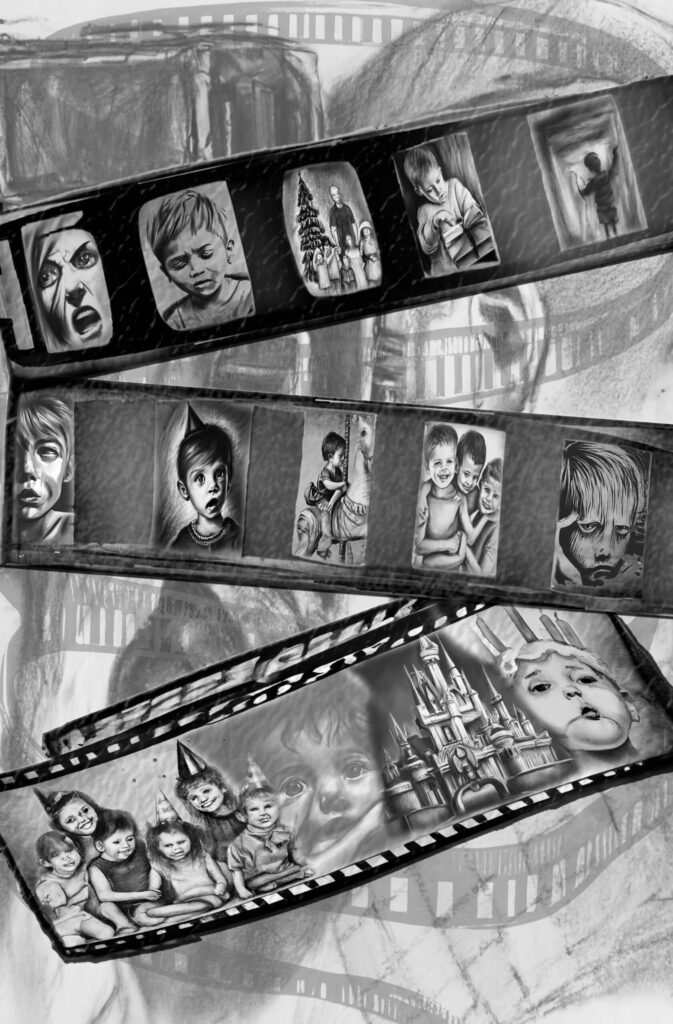
His mom returns to the dining room, wearing the same sheer-and-feather robe, but in black. She plops a worn, pleather-bound binder in front of him. The old man recognizes it instantly. He used to look through this book often as an adolescent. Maybe it made him feel like he was safe. Inside were ninety-six four-by-six glossy photos. The kind that you used to get from a one-hour photo shop when you took in a roll of 35mm or 110 film. Two photos per page, in chronological order. The old man doesn’t need to open the cover, despite his mother hovering expectantly over his shoulder. He knows exactly what’s inside. It starts with some pictures of his mom in a hospital bed, wearing a sky-blue sanitary apron with white trim. She’s sucking on a lollipop. Then there are pictures of him as a bloated, purple, dead-on-a-toiletseat extraterrestrial-in-diapers-and-a-onesie. Then some photos of him in a high chair with chocolate cake smeared all over his face. They’re all bordered by hand-drawn sunbursts and thought-bubbles that say shit like, “Look who’s one!” and “Havin’ fun with Grammie.” It goes on like that for a while. Childhood old man in a school play, dressed as a fly wearing a tie. Staged photos of his friends around a table covered in gifts as he blows out candles. The book comes to an end sometime around when he’s eight. By that time, his parents had three other kids to shower attention on. They’re more adorable at that age or whatever. The book cuts off around the same time as his memories started to disappear. Not his memories as a child, but his memories of being a child. He could remember these photos and the accompanying home videos, but he couldn’t remember anything else. Like these memories-for-show are all that are left of his growing up. He’d looked at the photos and watched the videos so many times as a child, they’d implanted themselves into his brain. Now, though, the haze was becoming clear. He was remembering all the stuff that gets edited out of “Family Times” VHS tapes. The stuff that doesn’t get a second print made when the film comes back from the photo lab.
Before everyone held one in their hand at all times, a camera was ever-present. You always knew it were there. Even if you tried to ignore the photographer so they could take a ‘candid’ shot, you were subtly adjusting your posture or turning for a more flattering angle. Video cameras were something else entirely. When someone’s dad pulled out the Magnavox or Panasonic, everyone was expected to smile and wave. “Hi, Mom,” was a standard response. The rubber eyepiece smashed to the right side of his face as he tried to support the weight with his shoulder, the dad would follow people around asking, “What are you doing?” and “Are you having fun?” Like, fuck, man, you have a camera, what does it look like I’m doing.
“What is this for?” The old man questions his mother as she retakes her seat. The wood chairs were all identical except for the two that had arm rests. Only mom and dad were allowed to sit in those.
“I thought you might want it.”
“Er, not really, you know I don’t keep stuff like this around.”
“Well, your dad already moved them to the computer, so I don’t need them any more.” She pointed to a digital LCD screen on the wall. Reflecting back a blackened void, it was obvious this is where she stored and displayed her horde of fantasy remembrances.
“Hang on, I’ll turn it on for you.” The old woman starts to rise.
“No, that’s okay, I know how they work.”
“Well, you should really take that album. Cherish those memories.” The old man has memories. Most of them are ones that he made himself. In the time after the missing pre-and-intra-pubescent period – the period that he was beginning to remember for himself again. The period not preserved on film and tape. But his most-cherished memories were preserved for posterity in his art.
“Okay, sure, whatever.” He left the unopened binder on the tablecloth, fully intending for it to remain there when he leaves.
“Okay, sure, whatever,” his mother mocks in her best patronizing voice. She returns to her tea, inhaling the putrid valerian aroma before taking a loud slurp. The old man recoils in a misophonic cringe.
“This sleepy-time tea is making me sleepy-time,” the mother pretends to yawn, finishing off the last of the tea-scum left in the bottom of her “Only the Best Moms are promoted to Grandma” mug. The saturated bag swats her in the face. Her press-on-nail finger holds the tampon-string against the rim of the mug as she tongues eagerly at the remaining drops.
“Are you going to stay tonight?”
“No, I need to take Shenzi back.” The old man isn’t sure why he came all the way up here in the first place.
“I thought you just picked him up.”
“Her. And I did, but I don’t know. I can’t remember right now. Maybe I’ll go home instead.”
“Okay, my son, I love you to the moon.” She kisses him on the top of the head and retreats down the darkened aggregate-floored hallway to the master bedroom.
“Alright, sweet girl, wanna go home?” Shenzi gets up excitedly from the spot in the living room where she’s been curled on the fresh cut-berber carpet.
“Let’s load up, baby.”
Shenzi races from the front of the house to the side of the towering Ford F-350 diesel extended cab. She sits patiently, staring at the white pull-handle on the side of the door, UPS what-can-brown-do-for-you paint slashed below. The old man opens the door and she leaps into the back seat and sits on the cushion, urging him to close the door so they can get going. More roads, more windows, more smells.Shenzi hangs her head out the window, paws on the armrest, reaching with her nose for as many scents as possible. The led-green speedometer needle points north-by-northeast as the diesel engine downshifts to accelerate to freeway speed. The old man tells her to get back in the cab, but she ignores him, straining to get every smell as the electric window slides closed.
The freeway curves to highway, redirecting the headlights in a north-by-northeastern direction. The glowing green point holds its position over the red “70”, backlit by strips of LEDs that are silicone-welded behind a pitch-black fascia that is meant to block out extra light from the instruments and indicators at night. People tend to think that there’s a special light for each of those numbers or dials, but it’s actually just a piece of black cardboard or plastic with holes die-cut in it to look like some high-tech lighting scheme. At least in the older models. The old man hasn’t driven anything new or exotic lately. His Fiat is no-frills. Utilitarian. They’re probably all LCD screens now.
Once again, the blue-yellow glow of intersections and gas station fueling bays fade in the mirrors and barbed-wire fence posts curve past the windshield and disappear out the side windows like dots in his periphery. Dark shadows of angus cows, Rorschach blotches over the moonless pasture. This may be a different highway than the one he took to pick up Shenzi, but they all look the same. Vast expanses set aside for ranchers to profit on the lives of animals. Meanwhile, millions of people starve in the streets. People who have passion in them. People who want to make a difference. People who could take a small parcel of land and make a life for themselves. That’s not immediately profitable, though, so fuck them, right?
Every fifteen or twenty miles, massive canopies of light pollute the night sky. Convenience stores are closed, but gas pumps are available for those who choose to, or are able to, use the banking system. Massive, blinding, halogen bulbs wash out the blackness, blinding the old man as he drives past, squinting against them to see the lines on the asphalt.
Between these monuments to profit and pollution are nearly identical subdivisions. Don’t say that to the residents, though. In this third development, the one the old man turns into, they have private security and a golf course and, gag me, an HOA. How dare you compare them to the next neighborhood, who don’t have, nor do they deserve, these amenities. There’s a defunct guard shack a mile down the road, a boom barrier on either side, permanently fixed in the upright position. Probably for the best. Word around the gossip mill is that the security guards here are former cops who were busted for being pedophiles. They still let them patrol around in fake Sheriff’s cars. This is supposedly where the development actually starts, at the former gate. So the people who live fifty feet on the other side are dirty slobs or something. Going into the politics and cattiness of homeowners associations is not worth my time to write, nor your time to read.
At the stop sign after the forever-empty rent-a-pedo hovel, the old man turns right and rolls down the back windows so Shenzi can take in the night air for the last bit of the trip. The roads narrow, wide enough for two cars, cars of regular size, but without lines to command the drivers to one side. The old man remembers driving these roads as a teenager, racing over the hills so his stomach would drop. Taking the corners wide and inside at high speeds, hoping another driver wouldn’t be coming from the other direction. His friend from high school and he had a running contest to break the speed record ‘over the bridge’ – a double-wide, concrete platform that sat only inches above a creek in the rainy season. It had been washed out more than a couple of times that the old man can remember.
Cresting the double-undulation ahead, the old man steps on the accelerator, launching the automatic transmission into lower gear. He experiences the intended reeling, plunging feeling. The same feeling you’d get falling from a skyscraper. In the truck, it only lasts for a millisecond. That familiar experience that lurches the old man’s organs into his throat and diaphragm, that feeling that makes him fear death, shoots through his body. He’s always had a love-hate relationship with this particular sensation. It was exciting. And it scared him. Roller coasters were no problem. He could sit stoically through the most intense loops and corkscrews. But those freefall rides – the ones with the cages that a group of people stand in, with no safety equipment except corroded boxes of human-welded steel. Those, and the modern type, where a dozen or so people are strapped in chairs on the outside of some glistening blue-and-silver tube with officially licensed cartoon characters on it. Either type. Those were the ones that got to the old man. He didn’t find them “scary” in the conventional way – the way he thought other people felt on thrill rides. The way his ex-wife would refuse to go on them. Not fear or anticipation, but a dark, almost sinister, feeling of foreboding would wash over him. Like how he’d always said the reason some animals freak out in response to sirens or fireworks is because they know what the end of the world is going to sound like. The old man wondered if they got the same feeling of imminent doom, the kind that he got when he went over these hills. Shenzi hangs out the opposite side, seemingly oblivious.
He hugs the outer shoulder, then noses inward to hit a perfect racing line through the apex. The motor revs and downshifts again. He stomps the pedal and hits the outside of the opposite turn. If someone came around this corner going the opposite way, he’d be a goner. He knew people this had happened to. Used to know.
The hills and trees take reprieve around the waterway overpass. Clutching the wheel with both hands at ten-and-two, he watches the green-ooze syringe count its way up the factitious numerals. The beastmobileometer slows its climb, pausing the needle as the giant tractor-tires hug the pavement. He looks up to correct the turn and evens out on the ‘right’ side of the road.
“Eighty-five!” the old man exclaims to himself. Supposedly, Rob hit ninety-one. There were no witnesses. But the old man had no reason not to believe it. He’d seen Rob do eighty-seven in his old ‘71 Charger. Though, he claimed he broke the record in his mom’s Volvo. It didn’t have the torque like his muscle car or this truck did, but it handled the curves infinitely better. And Rob was a walking stereotype of the energy-drinking, risk-taking, adrenaline-junkie.
I wonder what Rob’s up to tonight, the old man thinks and decides he should go find out. Rob liked to stay up all night writing code, so if he’s at home, he’ll probably want to hang.
At the next stop sign, the old man turns left, back to the main road that he came in on. Deeper into this suburban hellhole that’s been implanted into a pristine mountain ecosystem. The thoroughfare directs him around the algaefied, man-made pond that they call a lake. As a child, he’d swim in the slimy mud, despite the public (for residents only) pool being only feet away from the edge of the water. Some of his friends’ parents weren’t members of the exclusive house club, so they were barred from the chlorinated concrete hole. Now, the smell of pond sludge fills the cab of the truck and sickens him. Shenzi is loving it, though.
Rob’s house is not far from the lake-puddle. A couple more turns. Left one way, right the next, until the sign made of recycled barn-wood that used to spell out the family’s last name. Before several rounds of vandalization by the neighborhood teens. They have a steep driveway and the diesel engine roars as it makes the climb. The old man hopes he doesn’t wake Rob’s family, who sleep the prescribed amount of hours per night, at the recommended time each evening. The upstairs bedroom is dark and neither the Charger nor the Volvo are in the driveway. Instead of attempting to turn the giant truck around in the miniaturized cul-de-sac that serves as parking next to the house, the old man puts the transmission in reverse and lets the truck roll back down the driveway until the right tires stomp over the crumbling asphalt curb. He cranks the wheel and redirects the vehicle the way it came. If Rob isn’t around, he may as well go home.
“What are you doing?” The old man’s mother is standing on the hand-paved concrete in front of the house, watching him climb from the elevated cockpit. His dad’s Dodge Ram TurboDiesel is backed up to one of the many RV trailers, like they’re getting ready for a trip. Shenzi leaps down and runs to her, leaping up, tongue flailing.
“Shenz, get down, baby.” The old man calls after her.
“What do you mean? I was coming home from…I don’t remember, but I was at Rob’s house. Before that, I probably had work.”
“Have you been drinking?” She walks up to stare into his eyes. Squinting. Searching for miosis or mydriasis.
“What? No. I had to go pick up Shenzi. You know I quit drinking years ago.”
“Why?”
“Huh?”
“Why did you have to get the dog?”
“Um, I don’t remember. I must be getting tired. I can’t keep track of things right now.”
The old man follows his mother into the house. Her long, silken robe paints a wake of painted-pink feather boa for him to follow. Lipstick Lesbian Donnie Darko.
She turns on the automatic coffee machine and lets it warm up. It dispenses two hot mugs of plain water, one of which she places on the linen placemat in front of the old man, along with a myriad of herbal teas. He wonders why she’s never had coasters.
The boxes of teabags are fragrant and floral, most of them turn the old man’s stomach. Not finding a suitable evening alternative, he selects the Earl Grey and gently places it on top of the steaming water. After allowing it to naturally steep for three minutes, without any help in the form of dunking the teabag, he lifts the string to remove the saturated leaf-carrier. He then wraps the tiny cotton cord around the bag several times and pulls to squeeze the remaining liquid back into his mug. Aside from Matcha or Gongfu, this was the way he understood to make tea. Anyone who lets the satchel sit in the water for the entirety of their tea-drinking experience is sure to miss the subtle tones of the particular blend and, before long, run into bitterness as the tannins, or flowers, or herbs, take a nice, long soak, like they’d just pulled a double at the local steel mill.
“So did you hear? Cheryl got divorced and her husband, Cody, you remember him? The pastor at the church. Anyway, he was telling members of the congregation that his family had some medical emergency that he couldn’t or didn’t want to talk about and he told them that he needed money or they were going to lose their house.” This was one of those megachurches so, of course, the pastor had some garish mansion up on the highest hill in their HOA subdevelopment. “Turns out, and Cheryl never knew this, of course, turns out that he was stealing all that money. He even bought a boat.”
What the fuck kind of idiot buys a boat? The old man thinks. He’d given serious thought to money laundering in the past. He thought that the ways they showed laundry fronts on those streaming drama shows were not only glaringly obvious, but they were spending too much money operating the front business. Damn, you’d expect TV writers, with their mandatory ivy-league degrees, could come up with something even slightly clever. If he’d had the contacts, he would have gotten into the business – money laundering, not TV writing – and made sure most of the profits funneled back to the client. It’s pretty simple, really. You start a fake business that is entirely – or mostly – service oriented. But it has to be an invisible service. Something that you can’t measure in cash-register receipts. This is why car washes and dry cleaners and Italian restaurants are witless tropes. The catch, of course, is you have to be able to provide the service you advertise. Not to the public, mind you, and you don’t have to be good at it, but you have to have some kind of inventory or portfolio or something that shows that you’re not just creating fake invoices and receipts – which you are. The old man considered graphic design, website design, art gallery, and recording studio as good options. The two former can be done from a home office, the latter would require only a small rental space somewhere. Open by appointment only, of course. It’ll help if you have friends who are artists or musicians because then they’ll do the ‘work’ for you and you get to pay your friends to do what they’re passionate about. See, the thing about all these services is the prices charged in their industries vary wildly. Sure, my buddy might be able to do a logo design for $50, but how would the IRS know he’s not some in-demand pro who charges $400 an hour? It doesn’t matter anyway, you don’t have to hire either of these guys. You can, though – support the local artists. You will need some content, however you choose to source it. So once someone has a little portfolio of art or music or websites (They’re practically self-designing now), they can create a bunch of fake paperwork. They’d have to make sure that the total for each ‘client’ or ‘vendor’ is under the IRS minimum to require the creation of tax forms. Unless it’s the actual clients who want to show revenue – for the buying of boats and such. So this person with the “front” business, they basically make a small investment in something to support the arts community – allowing friends and creators to use the space or make the ‘products’. It’s about as low-overhead as one can get, the old man considers. Art galleries are even better – those prices can be inflated and reinflated exponentially. The same can be done with licensing intellectual property if a battery of physical art isn’t available.
“And then there’s the thing with Trisha and Carl. Have you heard about them?” How the hell would I? These are her friends, people he’d met once or twice, decades ago. Aside from the periodic gossip updates from his mom, he wouldn’t even know they still existed. She’s kept him up to date over the years of who has died from his graduating class. People he’d never looked up online. People he hadn’t thought about since high school. She would mention that this-person or that-person had died, filling him in on the details of an accident or suicide with a sparkle in her eye.
“Hold on, let me get something I’ve been saving for you.”
The old woman gets up from her wobbly oak dining chair. They’ve had this dining room set, his parents, for as long as he can remember. It’s one of those tables stained in a dark walnut to show off the wood grain. It can be round or slide open to have a table leaf added to seat six. The chairs are stained to match. Six chairs with identically-lathed back slats. Six chairs with identically-routed gothic or angelic patterns above eight identically-turned dowels. In all the years the old man can remember staring at the backs of these chairs, tracing the patterns with his finger, he still doesn’t know if it’s supposed to be plants carved into the backrests or something else. When he was a child, he liked to imagine the gouges in the wood were poison ivy with little barbs at the end. Maybe they were trumpets. Or talking flowers, like in that Rick Moranis musical. Though, he hadn’t seen that movie at the time. The old man wondered, with the countless times that they’ve changed the floors in this house, with the new cabinets and countertops, with the wall-sized TVs and top-grain three-piece leather sofa sets, with the luxury wallpaper and accent-wall repaints and custom wood chair rails, why did they keep this old dining table? And why the hell didn’t they have coasters?
Centered on the lazy susan, which was centered on the ever-present table-leaf, was a wooden box full of semi-transparent plastic bottles with matching white caps. It’s one of those boxes that’s supposed to look like bamboo, the sides joined together in that special Japanese notching style. In reality, it’s laminated pine.
The old man lifts the bottles out, one at a time, turning them so the label faces him. Lipitor. Omeprazole. Ergocalciferol. Fluticasone, expired, written to his father. Pantoprazole. Prescription ibuprofen. Tamsulosin, also for his dad, also expired. Potassium. Estradiol, expired. Zolpidem, two bottles. Lavender DoTerra. ArtNaturals patchouli. Miracle-brand sage oil.
Tucked in the corner of the pretend-hand-crafted box, not tall enough to peek over the top, is a blue bottle with a pointed white cap. The label has a red circle with dozens of red lines pointing decisively away from it. Like a distorted sun in a childhood drawing. The kind you’d hang on the fridge if the teacher didn’t want to, “talk to you about what’s been going on with little Jimmy lately.” The old man twists the white cone away from its bulbous base. He inverts the bottle and puts a few drops into his mother’s tea. Thinking for a moment, he empties what’s left of the six-milliliter squeeze-vial. The chamomile and valerian pickles the water as it cools.
His mom returns to the dining room, wearing the same sheer-and-feather robe, but in black. She plops a worn, pleather-bound binder in front of him. The old man recognizes it instantly. He used to look through this book often as an adolescent. Maybe it made him feel like he was safe. Inside were ninety-six four-by-six glossy photos. The kind that you used to get from a one-hour photo shop when you took in a roll of 35mm or 110 film. Two photos per page, in chronological order. The old man doesn’t need to open the cover, despite his mother hovering expectantly over his shoulder. He knows exactly what’s inside. It starts with some pictures of his mom in a hospital bed, wearing a sky-blue sanitary apron with white trim. She’s sucking on a lollipop. Then there are pictures of him as a bloated, purple, dead-on-a-toiletseat extraterrestrial-in-diapers-and-a-onesie. Then some photos of him in a high chair with chocolate cake smeared all over his face. They’re all bordered by hand-drawn sunbursts and thought-bubbles that say shit like, “Look who’s one!” and “Havin’ fun with Grammie.” It goes on like that for a while. Childhood old man in a school play, dressed as a fly wearing a tie. Staged photos of his friends around a table covered in gifts as he blows out candles. The book comes to an end sometime around when he’s eight. By that time, his parents had three other kids to shower attention on. They’re more adorable at that age or whatever. The book cuts off around the same time as his memories started to disappear. Not his memories as a child, but his memories of being a child. He could remember these photos and the accompanying home videos, but he couldn’t remember anything else. Like these memories-for-show are all that are left of his growing up. He’d looked at the photos and watched the videos so many times as a child, they’d implanted themselves into his brain. Now, though, the haze was becoming clear. He was remembering all the stuff that gets edited out of “Family Times” VHS tapes. The stuff that doesn’t get a second print made when the film comes back from the photo lab.
Before everyone held one in their hand at all times, a camera was ever-present. You always knew it were there. Even if you tried to ignore the photographer so they could take a ‘candid’ shot, you were subtly adjusting your posture or turning for a more flattering angle. Video cameras were something else entirely. When someone’s dad pulled out the Magnavox or Panasonic, everyone was expected to smile and wave. “Hi, Mom,” was a standard response. The rubber eyepiece smashed to the right side of his face as he tried to support the weight with his shoulder, the dad would follow people around asking, “What are you doing?” and “Are you having fun?” Like, fuck, man, you have a camera, what does it look like I’m doing.
“What is this for?” The old man questions his mother as she retakes her seat. The wood chairs were all identical except for the two that had arm rests. Only mom and dad were allowed to sit in those.
“I thought you might want it.”
“Er, not really, you know I don’t keep stuff like this around.”
“Well, your dad already moved them to the computer, so I don’t need them any more.” She pointed to a digital LCD screen on the wall. Reflecting back a blackened void, it was obvious this is where she stored and displayed her horde of fantasy remembrances.
“Hang on, I’ll turn it on for you.” The old woman starts to rise.
“No, that’s okay, I know how they work.”
“Well, you should really take that album. Cherish those memories.” The old man has memories. Most of them are ones that he made himself. In the time after the missing pre-and-intra-pubescent period – the period that he was beginning to remember for himself again. The period not preserved on film and tape. But his most-cherished memories were preserved for posterity in his art.
“Okay, sure, whatever.” He left the unopened binder on the tablecloth, fully intending for it to remain there when he leaves.
“Okay, sure, whatever,” his mother mocks in her best patronizing voice. She returns to her tea, inhaling the putrid valerian aroma before taking a loud slurp. The old man recoils in a misophonic cringe.
“This sleepy-time tea is making me sleepy-time,” the mother pretends to yawn, finishing off the last of the tea-scum left in the bottom of her “Only the Best Moms are promoted to Grandma” mug. The saturated bag swats her in the face. Her press-on-nail finger holds the tampon-string against the rim of the mug as she tongues eagerly at the remaining drops.
“Are you going to stay tonight?”
“No, I need to take Shenzi back.” The old man isn’t sure why he came all the way up here in the first place.
“I thought you just picked him up.”
“Her. And I did, but I don’t know. I can’t remember right now. Maybe I’ll go home instead.”
“Okay, my son, I love you to the moon.” She kisses him on the top of the head and retreats down the darkened aggregate-floored hallway to the master bedroom.
“Alright, sweet girl, wanna go home?” Shenzi gets up excitedly from the spot in the living room where she’s been curled on the fresh cut-berber carpet.
“Let’s load up, baby.”
Shenzi races from the front of the house to the side of the towering Ford F-350 diesel extended cab. She sits patiently, staring at the white pull-handle on the side of the door, UPS what-can-brown-do-for-you paint slashed below. The old man opens the door and she leaps into the back seat and sits on the cushion, urging him to close the door so they can get going. More roads, more windows, more smells.